blogger
Showing posts with label family. Show all posts

29 Dec 2013

This was shared with Matt McGaw and inspired him to come to Canberra, Australia.

"The church in Canberra is in need of genuine fellowship"

However, his report is that after speaking with two or three local churches he gave up and decided to develop his own congregation.

Why?  Because those he spoke with did not want to take up the revelation

What happened when others who did support him approached him?  He told them he was not interested in working with them.

Unfortunately this is sometimes the way when God speaks to those willing to hear him, not all are willing or capable of pursuing things his way.  They come with agendas and therefore filter the world and the people in it.  

It is difficult to understand in situations such as this how people can claim to desire genuine authentic fellowship but feel rejected by those who do not want it and reject those who do.

19 Oct 2012

Please first read Colossians 1

Are all people made holy through Christ?  Is he reconciling all creation to Him?  If so, then how are we to understand Ephesians 4?

Apostles. Prophets. Evangelists. Teachers. Pastors.  These are the five roles given for the equipping of the saints.  But pause for a moment ... are these words accurate translations?

Saints ... This is an English word used to translate the Greek word meaning sacred or holy.  It is the same word always used to refer to the Holy Spirit and Holy Scriptures.  As such, it is not surprising to see it in terms of God's holy people or saints.  But is that what has occurred here?  Does the next part of the passage which refers to doing the work of the ministry only refer to believers?

Equipping ...  To provide whatever is needed to make something perfect, mature, full.
Consider for a moment (John 14-15, Rom 2, Heb 8-10, Col 1) ... According to Jesus, truth and spirit influences everything and everywhere, whether or not it recognises it as doing so.  Therefore, what would happen if  this understanding were placed into the Ephesians passage?

The five roles were provided by God so everyone (and everything) God considers holy could be made perfect, mature, full in every way.

This is significant because it suggests that apostles, prophets, evangelists, teachers, and pastors were not sent for Christians.  Rather, they were sent for all creation, every part of it, including everyone regardless of their faith, experience of God, or acknowledgement of Him.

Could it be God is prepared to interact directly with people?  Could it be that people are not obligated to go to designated Christian places and spaces?  Could it be that we are to go to them?

27 Apr 2012

introduction
The use of terms referring to gender occur throughout the bible (e.g. mother, father, son, daughter, wife, husband).  Some apply to specific people.  Others provide information about a principle.  For instance:
  • Characteristics of a wife … (Ps 31)
  • How women should behave in church meetings … (1Co 14:34-35)
  • Definition of a widow … (1Tim 5)
  • How fathers need to treat their children … (Eph 6)
But how does reading Galatians 3:26-28 affect matters?

You are all children of God through faith in Christ Jesus.  And all who have been united with Christ in baptism have put on Christ, like putting on new clothes.  There is no longer Jew or Gentile, slave or free, male and female. For you are all one in Christ Jesus.

In other words, being part of God’s family means the divisions of heritage, social status, and gender are no longer relevant.  Does this mean you stop being a male or female?  No.  You still have the physical parts and the associated functions such as pregnancy and beard growing.  Then there are differences in hormones, emotions, etc.  So what exactly, does it mean for gender to be no longer relevant?

what does the bible say?
The starting point is to consider yourself in just one category: a child of God.  Do a word search of the bible using the keywords child and God.  How many of them refer to a gender?  What is common among them?
  • General information (Mt 5:9; Lk 20:36; Heb 12:7-8)
  • Connection to Jesus (Jn 1:12; Gal 3:7; Gal 3:26; Heb 2:14; 1Jn 5:1)
  • Where they come from (Jn 11:52; Rom 9:8).
  • Connection to God’s Spirit (Rom 8:14)
  • What God gives them (Rom 8:17-23; Gal 3:29; Eph 3:6)
  • How to recognise them (Mt 5:9; Phil 2:15; 1Pe 1:14; 1Jn 2:28; 1Jn 3:9-10; 1Jn 5:18-19)

fathers and their children
Choose one of the passages from the introduction, for example Ephesians 6: Fathers, do not provoke your children to anger by the way you treat them. Rather, bring them up with the discipline and instruction that comes from the Lord.

If gender is relevant to this passage then it’s request only applies to men who are fathers.  Everyone else, including mothers, could be considered exempt and may therefore provoke children and not be responsible for the discipline of children. Such a world would make the efforts of a father impossible, so why even ask it of him.

If at the very least mothers also need to discipline their children and treat them in such a way that they are not provoked, then we must re-examine how God views things.

widows
Now read 1 Timothy 5: a widow who is put on the list for support must be a woman who is at least sixty years old and was faithful to her husband…continue reading.

Why does God repeatedly associate widows with orphans and strangers in his word?  Could it be they are each a group of vulnerable people in the community?  If gender is relevant to this passage then it’s request only applies to widowed women.  Vulnerable elderly men could be considered exempt and we may therefore ignore their needs.

But read the passage in context.  Why were female widows even brought to attention?  Was there a cultural context? Do we simply transfer the action word for word, or do we need to look at the intent between the lines?

conclusion
Whenever you read something in the bible or are given advice, look at the underlying truths.  If God treats his children equally, then we need to live that way too.  Matters of character, principle, ethics, justice, love apply to everyone.  Equally.

26 Apr 2012

introduction
When you read the bible, how do you discover and understand what God means?  Do we simply read the words and go apply it?  Do we listen to a church sermon from or the advice of a Christian and simply do as suggested?

Why did Jesus say to the religious leaders and scholars of his day that knowing the words is not enough (e.g. John 5:39-40)?  What did he say we need instead?

Can understanding what God means occur by interpreting the bible through the lens of your society’s culture or your personal life experiences, preferences, desires, biases? (Isa 55:8).  Or should we be evaluating our culture and personal expectations through God's meaning?

Other things to consider:

[dropdown_box expand_text=" " show_more="click to read more" show_less="click to hide" start="hide"]

  • Context ... How much of the message are you being told?  A few words, a sentence or two, maybe a paragraph.  The sentences before and after a passage or quote often bring what is being said into focus.
  • Topic ... What is the real focus of what you are being told?  Is the passage or quote the focus of what is being explained or is it used to justify a predetermined theme or topic?  This is seen when a speaker starts with a quote but the rest of the time is used referring to personal and cultural concepts, ideas, presumptions, etc.
    [/dropdown_box]
    xample

example: friendship (top of page)
To explore this further, read John 15:12-15, a quote sometimes used to speak of friendship.

My command is this: Love each other as I have loved you. Greater love has no one than this: to lay down one’s life for one’s friends. You are my friends if you do what I command. I no longer call you servants, because a servant does not know his master’s business. Instead, I have called you friends, for everything that I learned from my Father I have made known to you.
(John 15:12-15)

In a recent church service, the speaker chose this to open a message about friendship (audio).

Was the surrounding text (context) spoken of (John 15:1-27)?  No, these were the only sentences used.  In addition, they were used to open the message, a message among a series about relationships (topic), and explored by a list of cultural types of friendship and concepts (e.g. purpose, value, time needed, number of people involved) about friendship.

Does this passage clearly state that Jesus is teaching about friendship?  Yes.

Does this passage give an explanation for how Jesus defines friendship?

No. It only reveals that he was talking about friendship.

Was the text explored before or after to discover whether Jesus gave any further.  No.

So, what is the context of what Jesus was saying?

What did he say both before and afterward?befo
re
the text before (top of page)
Jesus gives an analogy where He is a vine, God the Father is the viticulturist (grape farmer), and people are a branch.
[table id=9 /]co
mmandments
what does Jesus ask?
(top of page)
What are Jesus’ commandments?
  • That we love one another, just as Jesus loved us (and the Father loved him)
  • This means to lay down (sacrifice) your life for your friends
  • As a result, a friend is anyone who does this
The benefit of this is that Jesus will share everything he has heard from God the Father.after

the text after
(top of page)
Jesus continues his comments about friendship by stating that "the reason why the world hates you is because it hated him first."  Why?  Because when Jesus calls you out of the world you stop being part of it, and the world hates anything and anyone who is not part of it.  Consequently, since Jesus was persecuted, because God the Father is not known, so will you be persecuted. 
summary
summary (top of page)
To be a friend is to sacrificially love people.  This is how God the Father loves Jesus and Jesus loves us.  If you do:
  • You will be glorifying God the Father by proving yourself a disciple of Jesus
  • Jesus will share with you everything he has heard from God the Father
  • God will prune you in such a way that anything you ask of him will be done
  • You will be persecuted by anyone who doesn't know God
action plan: what to do next?
From the teachings of Jesus in John 15, is it possible to list the various types of friendship, or relationships we find in our society?  Is it possible to analyse their value or how to achieve them? Indeed does the teaching justify or prove our culture and personal expectations of friendship or other relationships?
If we take the teaching at face value, we must ask:
  • How do we love people sacrificially? How did Jesus?  How did God?
  • How do we prepare for and persevere through persecution?  What does persecution look like?
  • How does God prune us?
  • Do we limit our sacrificial love (friendship) to certain people or open ourselves to anyone?  What does this mean for our current relationships?  What does it mean for the people we currently exclude or don't see at all?

1 Apr 2012

Whose responsibility is it?

A woman is sitting on her own.  She is new to town and knows no one.  She does not even have family with her.

Whose responsibility is it to initiate an interaction.  Is it hers to introduce herself or for others to approach her?  Assuming she has a level of courage in this scenario, relationships could form even if no one approached her because she can make the first move.

But what if this lady has been experiencing some trauma in her life or something else that is causing her to hold back, to not make the first move? What if she is has a bad reputation or is physically unattractive?  What if her personality is different?  What if she has low self-esteem?  What if she finds it hard to trust people due to how she has been treated in the past?

Is it fair to suggest it was her responsibility if no interaction occurred?

What if this lady was you?

26 Mar 2012

11:26 am Posted by Bigfish69 Posted in , , , ,
"And the buttons glow in the dark"
It is great to revisit the parable of the prodigal son.  A story, amongst others, spoken by Jesus to the pharisees and teachers of religious law, and likely in the presence of the tax collectors and other notorious sinners who often came to listen to him.

The one lost sheep among one hundred.  The one lost coin among the ten.  The lost son
As I read this I see parts like the guy being lost, dead, etc... or about redemption, love, relationship... or attitude of the brother who stayed..,

Or when a message is preached from the pulpit I am reminded of how I am like the lost son or the brother who stayed is like religious people.  Great analogy as it meets the reason why Jesus said it to the Pharisees etc

But what I am also caused to contemplate is at what point did the lost guy stop being the father's son?

When he left home?  When he rejected his father?

Then why is he always  referred to as a son?  Could it be that he was the father's son before he left, while gone, and when he returned?  Is there any part of the father's behaviour which indicates he stopped considering this guy as part of his family?

The same is true of the sheep and coins.  Being lost, found, reunited did not mean introducing another species into the flock, or a spoon into the money bag.  They were sheep/coins before they were lost, while lost, and when found.  Those doing the seeking knew this.  Do we?

So now I must ask how this revelation applies to me?

How does this look in the context of Jews and Gentiles?

How does it affect my neighbours, colleagues, friends, family, etc in their own right as well as how I view them?

What  if they are protestant, catholic, baptist,  liberal, conservative, hindu, atheist, muslim, pagan, etc?  Does God consider all people regardless of their social or religious background part of his family even while they are practicing it?  If no, then I must reevaluate how he viewed and even now views me.  But if he does, why don't we do the same?  Why do we treat people as if they are family only when they cross the official line of "being saved"?  Let's be honest, even that is often lacking unless a person meets our own personal preferences.

And if he has always considered us family, then I must go to him again and ask what he means by salvation, redemption, and restoration.  Is it about healing and making things right amongst his family, or about transforming spoons into coins, cows into sheep, people into christians?

15 Mar 2012

9:39 am Posted by Bigfish69 Posted in , , , , , ,
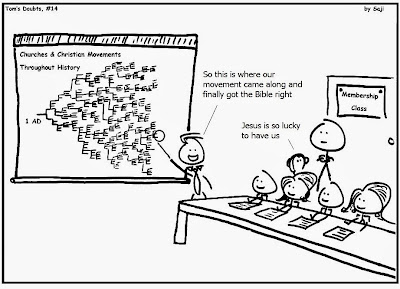
Church and Christian movements throughout history
Anglican, Apostolic, Assemblies of God, Baptist, Catholic, Christian City Church, Christian Revival Crusade, Church of the Nazarene, Churches of Christ, Eastern Orthodox, Lutheran, Pentecostal, Presbyterian, Reformed Churches, Salvation Army, Uniting, Vineyard, Wesleyan Methodist…

»  Is the church, God's family healthy today?
»  Is it mature in the likeness of Christ? (Ephesians 4)
»  Has the task Jesus set before us been completed? (Matthew 23:18)
»  Do we love others as God loves us (1 Peter)?
»  Are we one as Jesus and the Father are one? (John 15)

These are just some of the many and varied Christian groups in Australia, whether they are called churches, denominations, or movements.  This is not to mention all the ‘independent’ or non-aligned ones, as well as home churches.  Furthermore these are then subdivided.

Why the Division?
  • Disagreement over the interpretation of God’s word
  • These disagreements can be taken personally and become points of conflict
  • Refusal to resolve differences
  • This can lead to people pursuing their own self-interests and agendas
These are just some of the many and varied Christian groups in Australia, whether they are called churches, denominations, or movements.  This is not to mention all the ‘independent’ or non-aligned ones, as well as home churches.  Furthermore these are then subdivided.

Often disagreement can occur over how God’s word should be interpreted and therefore lived out and sometimes these disagreements are taken personally and become points of conflict.  When this occurs and people may refuse to resolve their differences making the conflict more permanent.

Does God approve of division among his family?  Is there room for unresolved arguments between individuals or groups of people?  Does it ultimately matter how we interpret God’s word?  Should people justify their positions?

»  What did Jesus say about a division? (Mark 3)
»  Is Christ divided?  Was the founder of your church crucified for you? Or were you baptised in their name?
»  What was happening in the Corinthian church? (1Corinthians 1-3)
»  Why did Paul refer to divisions as like acting like people who don't know Christ at all?


Have another read of the New Testament.  Look up and compare what is written about tribal separations (e.g. divide, segregation, arguing, strife) in contrast to unity (e.g. oneness, togetherness, fellowship).

Ultimately disagreement is a natural part of life.  However, is allowing it to continue beneficial (Ephesians 4:26-27) regardless of how strongly you feel about it?  Is it justifiable for division to go so far as to cause people to not only view themselves as part of different churches, but to believe their church has the one true truth?

If your answer to any of these questions is no then why do we continue to enable the situation?  Why don't we forgive? Why don't we love our enemies?  Why don't we try to resolve the hostility existing between people who claim to pursue Christ?

When you look at the various groups who gather in the name of Christ, do you observe that the conflict, misbehaviour, and even abuse of some is accommodated for by others (e.g. ignored, excused, glossed over, covered)?  Would you agree that this has been going on for so long that individual believers have spent their entire faith life seeing this kind of relationship as normal?

When you observe the church, do people tend to be passive?  Maybe they provide care in such a way that negatively impacts themselves or the ones being helped?
But isn't putting others first essential to following Christ?  Yes and no.  God asks us to be generous with all we have, including our very life, but not to the point where we need the welfare of others.

Are there behaviours, thoughts and feelings that go beyond normal kinds of self-sacrifice or care-taking.  For instance, do people or groups act as martyrs?  Do they help others to attract attention and sympathy as they feign exaggerated suffering?  Do they need to be needed?

A broader example is an ongoing need to be accepted, whatever the cost.  Thus when they disagree, they take the role of the victim, and feel guilty about standing up for themselves.

The term describing the refusal or inability to talk about relationship problems is dysfunction.  It is a term commonly used within families.  And if church can be considered as God’s family, it makes sense to examine our situation in this light.

To think about dysfunction within the church means considering it in terms of:
»  your own behaviour
»  your local church or congregation,
»  your church's main leader,
»  the denomination or movement in which you find yourself, and
»  the church as a whole in your area, your town, your city, your region

Dysfunctional Survey - Personal Dysfunctional Survey - Local Church Dysfunctional Survey - Leadership Dysfunctional Survey - Regional Church

14 Mar 2012

10:34 am Posted by Bigfish69 Posted in , , , , , ,
GALILEO (Rome 1610)
What did Jesus mean when he said people no longer need to go to the Temple of Jerusalem or the altars of the mountains to worship?  But instead the Father seeks people to worship him in spirit and in truth (John 4).

Is it possible that church is something other than a building we go to on Sundays to listen to a message about God?  And if so, could church be something beyond Sunday itself?
Have another read of the New Testament.  Search words like "body" and "temple" and consider those passages that use them as analogies to people who believe in Christ.  What is being shared?

Could church simply be who we are because of who God is?

And if so, then this applies to anyone including yourself.  Now ask, when was the last time you stopped being you?  Indeed, will you ever stop being you before death?  In short, you are always you, 24 hours a day 7 days a week.  And as such, church being people exists all the time: at a Sunday service, at the shops, at work, walking the dog, eating breakfast.  Yes, even while you sleep.

One more step, with a deep breath.

The bible repeatedly refers to individuals who are reconciled with God as His children.  Likewise the bible refers to groups as children of God, brothers and sisters in Christ.  What does this make you think of?  Where do you hear terms like father, brother, sister, children, etc?  Family.

In addition, what was intended by Jesus’ death and resurrection?  What does it mean when an act applies once and for all (Hebrews 10)?  What does it mean when a gift is given free of charge (Romans 6)?  Use a dictionary to learn what it means to redeem something (Luke 1)?

Was this only applicable to the people alive ca.33AD?  Did it apply to people who later heard the message, also at that time?  What about today?  If Jesus’ sacrifice to free people really was a once only action, are people free because they believe it happened or simply because it happened?

And, if people are free because it simply happened, then who are free?  Christians? Everyone? Christians who do and say the right things? Buddhists? Muslims? Hindus? Catholics?  Anglicans? Pentecostals? Atheists? Who? This is not a comment on what a person does with their freedom.  The question is whether or not people need to do something to gain their freedom.

Take care.  There was once a time when you too did not acknowledge God as being real, let alone what he did for you.

Remember, have another read of the story about the prodigal son (Luke 15).  Did the son ever stop being a son?  What does that imply for Buddhists, Muslims, Hindus, Catholics, Anglicans, Pentecostals, atheists, etc?  How does our idea of who is part of, or excluded from, God's family match up with his?

Review …
  • If church is who we are because of who God is, then there are implications for when and where church occurs.
  • If church is God's family we need to better understand who he considers is part of it.
  • If we are not upholding God’s values then we must ask ourselves what we are really doing.

28 Feb 2012

Today, the church often preaches about how God is all about relationships and as such so must the church.  We therefore have become accustomed to filtering what we do through the lens of relationships.  For instance, we only have the right to speak into another persons life once we have a relationship with them.  This is despite the fact that our very presence can be enough to affect another person's life, without have ever spoken a word to them let alone having met them.

We have also made our theology of God all about relationship.  God is the father, son, and spirit in continual relationship.  Occasionally, some believers will take the bold step and suggest people are invited into this relationship.

Now don't get me wrong, I am not opposing the importance of relationships.

But what I am pointing out is two things.  First, treating relationship this way is like the story of the elephant, where different people describe the elephant according to which part they were looking at: a leg, a trunk, an ear etc.  And as such they each spoke of the elephant in terms of the piece they could see.  Alternatively, what if the elephant is up a tree?  What if what we are describing looks like what we would expect a certain part of the elephant to look like, but we our expectations keep us distracted from looking up?

If we are doing this with God in terms of relationships, then what are we making the cornerstone of our faith and why?

Thus, the second point.  Could it be because our culture and society lack genuine relationship causing it to be the cry of our collective heart?  Could there be something more than what we experience through individualism?  Irony, in a desire to overcome individualism, we segment God into parts, father, son, spirit and then resolve this in terms of relationship, where we relate to one or more as our needs determine.

Again, not disregarding or diminishing relationship, trinity, or God's attributes. Just wanting to prompt us to consider what we doing and why.

Oneness

Jesus prayed that we be one like he and the father are one.  Is there distinction?  We are called to mature so we may be as the full stature of Christ.  We are to be in him and he in us... etc

This is like describing the colour green.  Yes we know and can show that yellow and blue are the component parts, and in a sense when we interact with green, we interact with mixed parts of yellow and blue.  But the truth is when you look at a frog or a leaf, you don't think or behave like that.  You only treat it as green.  We are not even contemplating how the bits work together.

Again, it is like when we send a christmas card to a household or a wedding gift.  Though we recognise each person involved, our focus os on the family, the couple.  Our love is for them as a whole.  Indeed, you may even sign off using your own family's surname.

The mystery that is God, the Church, etc...  Breaking him/us down while not 'bad', misses something.  And if we are doing this because of something we are missing in ourselves, communally or individually, then hmmm.

I pray that we are resolved in ourselves on this matter so that we may be one with one another and one with God.  And as such, just One.

27 Jan 2012

If God desires there be no division between his people, where do denominational groupings within the church fit? What about those who are called believers and unbelievers

Paul appealed people to live in harmony with each other, without divisions in the church. To be of one mind, united in thought and purpose... Some claimed to be a follower of Paul, others Apollos, others Peter, or only Christ. But Christ is not divided into factions. Nor Paul crucified for you? (1 Corinthians 1:10-13)

After all, who is Apollos? Who is Paul? We are only God’s servants through whom you believed the Good News. Each of us did the work the Lord gave us. It’s not important who did what, but rather that God makes the seed grow. (1 Corinthians 3:5-16)

How does this apply when people say “I am a Baptist,” “I am Catholic", or “I adhere to no set denomination”, etc?

Was your minister, pastor, priest, mentor crucified for you?

If Christ is not divided into different groups, what are we doing?

If Jesus ended division by terminating the system of law with its commandments and regulations, then are the requirements we expect of people to belong relevant? If not, what do they do? How?

What are we to make of the promise of Christ in that there is nothing a person needs to do for God to forgive and embrace them? For all people? For all time?

Does placing requirements on people to belong create barriers to what God wants to do?

What are the commandments and regulations the church imposes today to belong? 
Consider things such as attendance of services, how we speak, what we wear, who we interact with, permitted activities, etc. Consider things such as how to pray, worship styles, or what it means to become saved.

What are the alternatives?

29 Dec 2011

dream
I was within a corporate building upon a floor with lots of rooms and offices.  Within one of these rooms I was speaking with a young lady, of the Islamic faith, who I used to work with in the kitchen of a nursing home.  As we spoke my left arm rested atop her right arm, including our hands.  In knew in this acton great affection was being expressed.


interpretation
According to muslim dream symbolism, limbs represent family amd arms brotherhood.   A muslim to dream of holding a woman represents loving the world and rejecting the afterlife.  However this dream, if of God cannot be viewed this way.
  • The dream is not specific to this lady, her image was used because she is one of the few Muslim I personally know.
  • Women represent God's people, thus the context here is people of the Islamic sphere.  They are people he is seeking.
Thus, this dream is a parable in nature.  It challenges people who profess Christ to treat Islamic people as God does, as his family regardless of your views on reconciliation.  It also challenges people of the Islamic faith to see God as relational, to reject the world and embrace eternal life.  Both are counter cultural.

3 Oct 2011


Watch out for people who cause divisions and upset people’s faith by teaching things contrary to what you have been taught. Stay away from them. Such people are not serving Christ; they are serving their own personal interests. (Romans 16:17-18)

 features of a sectarian church group
  • Members point to the importance of their group and/or leader instead of Christ alone.
  • They claim to support the universal church, the body of Christ, but in practice promote structures and attitudes that lead to their own isolation.
  • They may claim their group possesses “the real truth”
  • The ministers/leaders claim to be the ones God reveals things to. People are either not encouraged to listen or understand God for themself, or told there are certain things God speaks to the leaders alone.
  • The praise and warmth people receive when they first join continues only as long as they follow what is expected of them.
  • Other groups of believers (Christians) are criticised or mocked.
  • A belief exists that “our group” can’t learn from others who do/see things differently.
  • People and groups who disagree with them are slandered.
  • People and groups who reject their version of the truth are viewed as dishonest, insincere, offensive, immature, not living right, etc.
  • Anyone and any group who don’t accept their teaching are cut off or isolated.
  • Ministers/leaders control the way people live and their activities by requiring permission to do things or expecting direct input.
  • They are typically not upfront about their core beliefs.
how to avoid joining a sectarian group
  • Ask people and the leaders of the church why people leave their group.
  • Ask to be able to speak with the last 3 families that left.
  • Ask who God speaks to within their group and whether people are encouraged to understand what he says. Ask how and who teaches people how to hear God clearly.
  • Are people freely encouraged to share what they believe God is saying? How?
  • Ask how interaction with other church members outside their group is encouraged. Is action left to the leaders or for anyone?
dangers of joining a sectarian group
  • They will replace the guidance of the Holy Spirit with their own, or of the ministry, or church, and claim to be the voice of the Lord.
  • You will be influenced to have prejudice and intolerance toward other Christians.
  • You will be influenced to invite people to belong to the church group, instead of Christ.
  • Your spiritual and day to day life will become controlled.
  • Their ministers may try to lead your family.
  • If you query or speak against the group, your family may have wedges placed between its members.
  • If you leave, they may expect your children and spouse to stay.
  • If you leave, they may deal with you unfairly and harshly.

29 Aug 2005


Youth With A Mission (YWAM)

To whom it may concern,

I hope this letter finds you and yours well.

The following information is something I believe I heard for the people of YWAM.

The request was for us to please read Paul’s letter to the church of Ephesus.  And as such, it was my understanding that the foundations of the ministry, which is YWAM, have shifted.  The need to equip remains.  But the apostolicness is to increase.

What does this mean?  Basically my understanding is YWAM is (or was in 2005) primarily acts as a ministry which invites people from afar to come and learn how to be missionaries or add to their ‘tool kit’ of being a missionary.  However what I am hearing is a call to, for example, increase
  • from being a ministry of teachers to one of empowering a missional community
  • from inviting students to a centralised base to going out to where people are
  • from teaching those with a call to empowering those who have been called, even before they themselves know they have been
It is not my intent to suggest that you are not already doing these things.  Not at all.  Simply to encourage you to continue seeking God in all manners relating to Him and His Kingdom.

If you would like to question me on any of what was shared here, I would be more than happy to make myself available for you: benfam@gmail.com

bookmark kingfisher

Facebook Favorites More Twitter

subscribe

Search